Stephen Eades – Retirement of Hugh Rout – Jan 2026
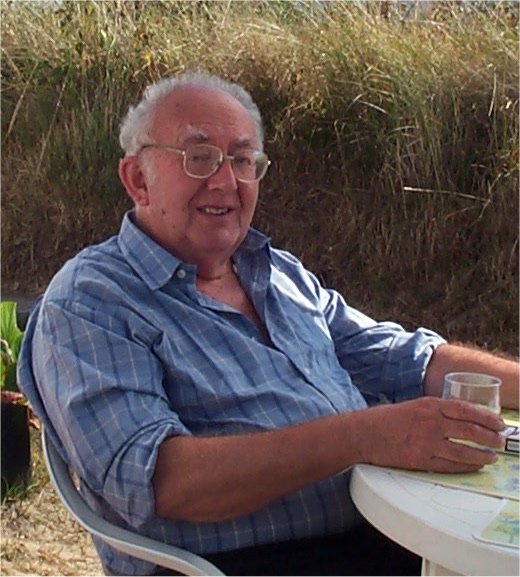
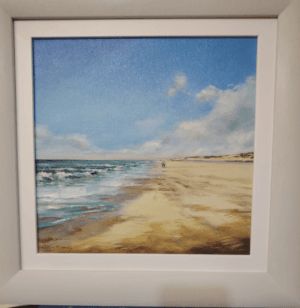
Since the earliest days of Marinet, going back to when it was founded by Pat Gowen and colleagues in the early 2000s, Hugh Rout has been our webmaster and the website today is a huge tribute to his work. Hugh has now had to retire from those duties, and we have presented to him the picture you can see here of the Norfolk coast. I know all Members will want to thank Hugh, and to wish him the best in the future.
Our new webmaster is Alan Pinder, and we thank him greatly too for taking on this task.
Another person you may wish to know more about, especially if you never met him, is Marinet’s founding chair, Patrick Gowen. We wrote a tribute to Pat which you can see in the second part of our publication Sand, Sea and Sewage on our website.
We also reproduce that tribute below and, if you visit Sand Sea and Sewage, you will see the quality of campaigner that Pat was. He set the highest standards, and achieved a great deal. His work is a very fine example of the methods of campaigning that members and all local campaigners may find of real value.
Sand, Sea and Sewage
The history of our campaign to address the health threats imposed by marine sewage pollution, and the nature of the response by government in the light of the European Bathing Water Directive, 76/160/EEC.
Author: Patrick Gowen
First published by Marinet, January 2018.
Second edition, revised, May 2020.
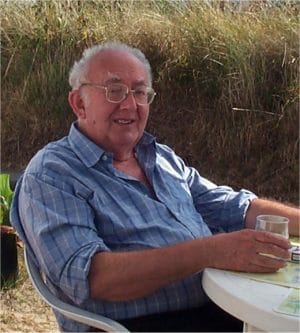
Patrick Gowen
Preface
The author of this article, Patrick (Pat) Gowen died in August 2017 (1932-2017). He was a founder member of Marinet and its first Chairman at the time of Marinet’s establishment in 2002. In 2017, when his health was declining, he asked me to act as an editor for him and to complete this article based on the written text he had finalised for the first half and his notes for the second half.
This I have now done, and this article is the outcome. It is an extraordinary record. It is extraordinary not just because it records clearly the deviousness of government in seeking to evade its responsibilities, in this instance with respect to the safety of sea bathing waters and the scourge of sewage pollution, but also because it is a testament to an exceptional person who, with colleagues, selflessly gave himself to years of environmental campaigning — effectively his lifetime — and to serving the public good and doing so entirely voluntarily and for no personal benefit.
Professionally, Pat Gowen was a man of many abilities. Primarily a scientist, Pat joined the Biophysics Department at the University of East Anglia shortly after it was established, and it was here that he became a Chief Technician and earned his living until he retired. Pat was also a person of strong conviction, and he said “I decided that as a scientist, I could do more as an activist. At some point you have to stand up and be counted and speak for the environment.” The account he relates in this article is exemplary evidence of this belief.
His abilities and activities were not restricted to environmental work alone. He was also a highly qualified and accomplished amateur radio operator, and he became a Director of AMSAT (the Radio-amateur Satellite Corporation) based in Washington DC, USA. This involved him in the design, building and launching of free access satellites for the radio amateur for their own use in communications, education and research, with these satellites managing to secure a “free-ride” on NASA’s own weather and earth resources satellites.
In 1978 the USSR version of AMSAT — known as DOSAAF — put a pair of amateur satellites into orbit with a COSMOS launch, and it was for his original work through and with these spacecraft which led to the award to Pat of a COSMOS Diploma and Gold Medal.
However it was not until around 2000 that the paths of Pat and myself crossed, the issue of sewage pollution of our bathing beaches being the meeting point. In subsequent years I came to know Pat as an environmental campaigner of immense conviction and ability. Not only did he give unstintingly of his time and pioneering campaigning mind to sewage pollution, but also to another scourge that affects the coast of East Anglia — commercial offshore aggregate dredging for sand and gravel from the seabed, and the profound consequences this has and still does have on the quality of beaches, coastal sea defences, sea fisheries and marine life in general.
Almost single-handedly Pat developed the campaign and expertise that first challenged these UK-wide offshore aggregate dredging practices — now supplying around 20% of sand and gravel throughout the UK, and more than 80% in London. Whilst chairman of Marinet he established the marine aggregate campaign as one of the principal components of Marinet’s work and this still remains the case today.
Pat and I were founder members of Marinet — he as chairman and I as its co-ordinator, and throughout the years that I worked alongside him I could be certain that he would always remind me of the basic principles involved in our campaigns, and I could be certain that he would chide me and others if we had overlooked something fundamental. He set standards for a focus on truth and accuracy that were unwavering and he had little time for those who would dissemble from such a commitment.
I believe you will find this clearly evident in the facts related here in his article.
It is neither exaggeration nor unwarranted praise to say that knowing Pat and working with him has been one of the privileges of my lifetime. His like are not easily found, nor replaced, and the mark he has left through his life and its endeavours are a benchmark by which any young person seeking to defend the environment today could well measure themselves. There is no doubt, we are in urgent need of more of his calibre.
I would not want to seem to be putting Pat on a pedestal. He was too modest a man to permit anyone to do so and he had a sharp wit and eye for debunking all those would seek to govern and administer in this way.
In 2008 he sent me an item tilted “one NOT for the website”. I reproduce it here:
Science Reveals Heaviest Element Ever Discovered
Research has led to the discovery of the heaviest element yet known to science. The new element, Governmentium (Gv), has one neutron, 25 assistant neutrons, 88 deputy neutrons, and 198 assistant deputy neutrons, giving it an atomic mass of 312.
These 312 particles are held together by forces called morons, which are surrounded by vast quantities of lepton-like particles called peons. Since Governmentium has no electrons, it is inert; however, it can be detected, because it impedes every reaction with which it comes into contact. A tiny amount of Governmentium can cause a reaction, which normally takes less than a second, to take from four days to four years to complete.
Governmentium has a normal half-life of 2-6 years. It does not decay, but undergoes a reorganisation in which a portion of the assistant neutrons and 20 deputy neutrons exchange places. In fact, Governmentium’s mass will actually increase over time, since each reorganisation will cause more morons to become neutrons, forming isodopes, not to mention multiple oxymorons.
This characteristic of moron promotion leads some scientists to believe that Governmentium is formed whenever morons reach a critical concentration. That hypothetical quantity might normally be called “critical mass” but, in this unique case it is known as “critical mess”.
When catalysed with money, Governmentium becomes Administratium (Am), another just-discovered element that radiates just as much energy as Governmentium since it has half as many peons but twice as many morons.
Whether Pat wrote this himself, I do not know. However I feel it almost appropriate to attribute it to him. He had the measure of his opponents and, if he had more resources, he would certainly have been classed as “dangerous”.
Pat was, in my experience, very much a democrat. He was a strong believer in the rights of the ordinary person and the protection of those rights, especially when challenged by government or the bureaucratic system. However he was sharp enough to know how to use government and larger organisations to advantage, as the narrative relating to the Bathing Water Directive will demonstrate, whist being equally conscious of how government and organisations can and do suppress progress and good sense.
Thus, after a period of intense frustration and growing disillusionment which led to Marinet to decide in 2015 to part ways with its parent organisation, Friends of the Earth, he was a strong supporter, indeed advocate, of that decision.
He believed in progress, always challenging those who refuse to accept the necessity of progress; and, although he was not able to take an active part in the independent Marinet in his final years, he believed in the vision and sense of commitment to secure real change for our seas and ocean which Marinet’s independence has heralded.
He was a person of very great commitment and vision. This is his legacy. It embraces us now and, I trust, we will in the future continue to embrace him equally strongly and so sustain his legacy to us.
Stephen Eades.
Director, Marinet Limited.
Marinet owes Pat its future and present direction. He was a Chairman with integrity and vision and he led by example which Stephen and I have always tried to emulate. His enthusiasm was infectious, he always hoped the environmental lobby would pull together but never lived to see it. We will miss his guidance as our first Life President.
David Levy, Current Chairman